
A Mahal is the Persian rug for a big room that needs pattern without busyness. Mahals are hand-knotted in wool in the villages around Arak, a city in west central Iran that was called Sultanabad until the late 1930s, and they are known for large flowers, long curling vines and plenty of open ground between them. The weave is coarser than a city rug's, with fewer knots to the inch, so the weavers made each flower big instead of crowding in small detail. That is why Mahal Rugs look spacious, and why they work in large living and dining rooms: the pattern stays calm from across the room instead of reading as busy.
Two other names come from the same region, and dealers use them to sort these rugs by grade. Sultanabad is the name the trade gives the finest of the spacious carpets: the same open layout, woven more finely, with smoother curves and more detail inside each flower. Many were made from the 1880s on for European firms that set up in the city and had carpets woven in the room sizes Western houses needed. A Mahal is the next grade, with bolder, simpler flowers; to see the difference, set a Mahal beside the rugs in Sultanabad Rugs. A Sarouk, from a village north of Arak, goes the other way: a dense, thick pile and smaller flowers packed close together, often on a deep red field, as in Sarouk Rugs.
How to recognize a Mahal
Look at the scale first. Across the field, the open center inside the borders, a Mahal repeats a few large forms: palmettes (the fan-shaped flower of Persian design), rosettes and broad leaves, set well apart and joined by vines in long, loose curves. The border is usually wide, a main band of flowers between narrow stripes, and often in a contrasting color. This Antique Mahal Area Rug (9' x 12') is the type at its most typical, large ivory and pale blue palmettes on a rust field inside a dark slate border.

Mahals come in two layouts. Three in four of ours have no medallion at all: flowers and vines repeat across the whole field, so no piece of furniture has to line up with anything. The other quarter set a medallion in the middle, like this Antique Mahal Area Rug (9' x 13'), where a small sage and ivory medallion sits on a terracotta field with flowers running all around it. A few use a smaller, tighter repeat of the same flowers, the closest a Mahal comes to the detail of a city rug.
Choosing a layout and size for the room
The layout tells you where a Mahal belongs. An all-over floral field suits a room where furniture covers much of the rug, under a dining table or a bed, because the flowers keep showing between the table and chair legs. A medallion gives a living room a center, so keep the middle of the floor open and gather the sofa and chairs around it. For size, close to half of the Mahals we have are 8' x 11' or larger, enough for a full seating group or a table for six with its chairs, and 8' x 12' is the most common of those sizes.
 Floral Mahal Rugs
Flowers that keep showing between table and chair legs.
Shop
 Medallion Mahal Rugs
A center for the sofa and chairs to gather around.
Shop
 Large Mahal Rugs
Room sizes for a full seating group, most often 8' x 12'.
Shop
Antique or vintage
Both come from the same villages and the same patterns, so the choice is about surface and size rather than quality. An antique Mahal, meaning a rug eighty years and older, has usually worn its pile low, so it lies thinner and flatter and its colors have softened further. A vintage Mahal keeps more wool standing and feels fuller underfoot, the easier choice for a family room that sees daily traffic. Size often settles it: of our 29 large Mahals, from 6' x 9' to 10' x 13', 25 are antique, while seven of our eleven 4' x 6' Mahals are vintage.
 Antique Mahal Rugs
Pile worn low, and most of our large sizes.
Shop
 Vintage Mahal Rugs
Fuller underfoot, and most of our 4' x 6' sizes.
Shop
Terracotta, faded or neutral
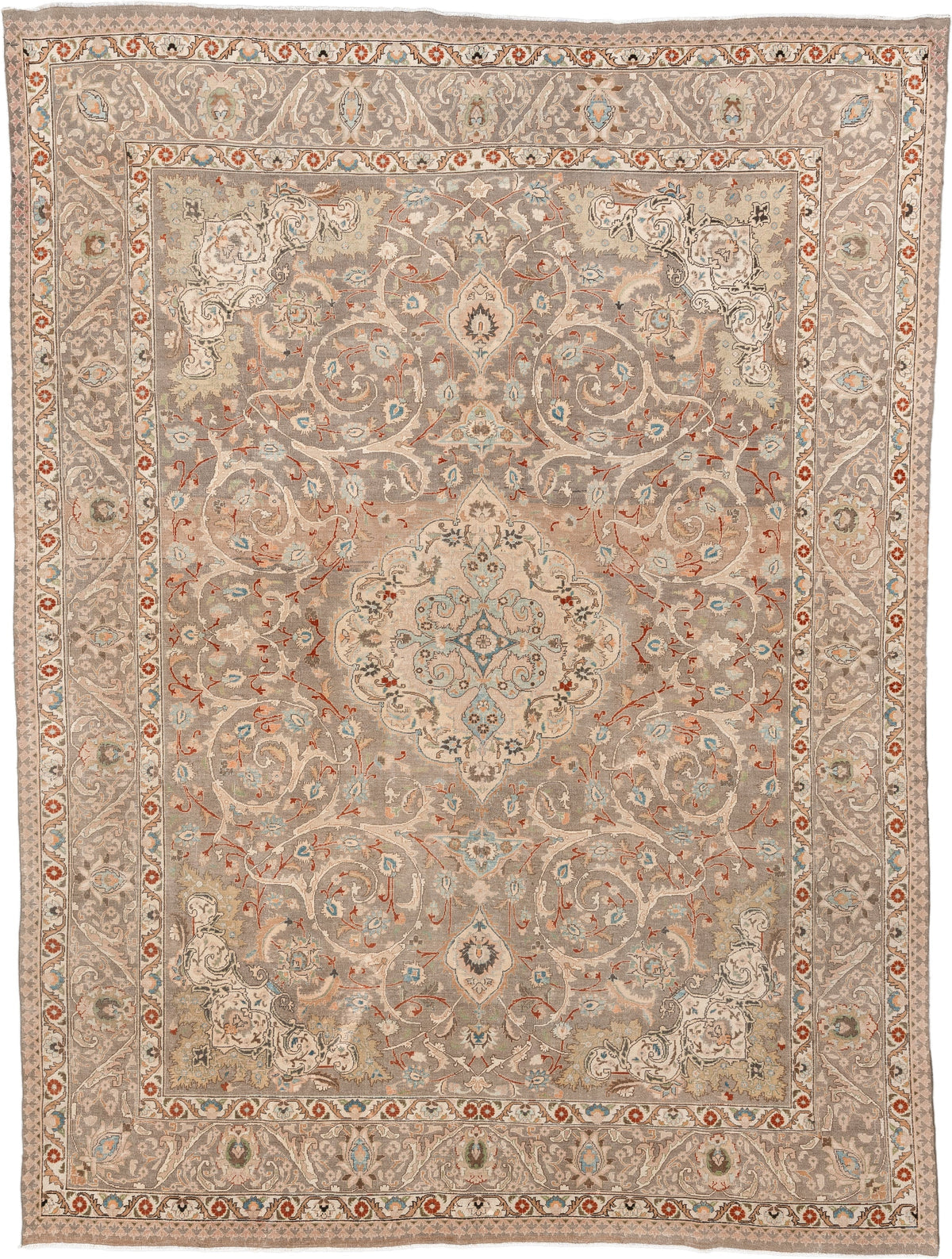
Most Mahals are warm. Nearly half of ours have a terracotta field, the soft clay red many Mahals are known for, and it suits a dining room with dark wood furniture or a living room that gets little sun. More than eight in ten have faded, their reds and blues washed back toward rose, sand and pale blue, so even a large Mahal reads as soft color rather than busy pattern. A smaller group of eleven sits in ivory, taupe and gray, the quiet choice for modern furniture and pale walls; this Antique Mahal Area Rug (8' x 11') has a taupe field with charcoal flowers and corner pieces.
 Terracotta Mahal Rugs
Soft clay red for a room with dark wood furniture.
Shop
 Faded Mahal Rugs
Reds and blues washed back toward sand and pale blue.
Shop
 Neutral Mahal Rugs
Ivory, taupe and gray for modern furniture.
Shop
Placement follows the size. In a living room, rest at least the front legs of the sofa and chairs on the rug. Under a dining table, leave about two feet of rug past the table edge on every side, so a chair pulled out stays on it. Care is simple: put a pad under the rug on hard floors, vacuum without the beater bar, rotate it once or twice a year so sun and traffic wear it evenly, and send spills to a professional cleaner.
If you are shopping the type rather than one particular rug, choose the size first and the color second. This Antique Mahal Area Rug (9' x 13') is the classic version: big pale blue and ivory flowers on a terracotta field inside a sky-blue border. For the largest rooms, this Antique Mahal Area Rug (11' x 16') spreads a faded rose field inside a golden border. Every Mahal we have is hand-knotted and one of a kind, the kind of rug a living room or a dining room is planned around.
One of a kind, photographed flat Every Mahal in the shop, on one page Explore All Mahal Rugs