
A Tabriz is the Persian rug to choose when a room is formal and the pattern has to hold up at close range. Tabriz is a city in northwest Iran, and its rugs are workshop rugs: hand-knotted in wool from a design drawn out in full on graph paper before the first knot is tied, one square on the paper for every knot on the loom. That paper plan is why Tabriz Rugs look the way they do, with medallions centered to the knot, borders that turn their corners cleanly, and curving vines that stay smooth instead of breaking into steps.
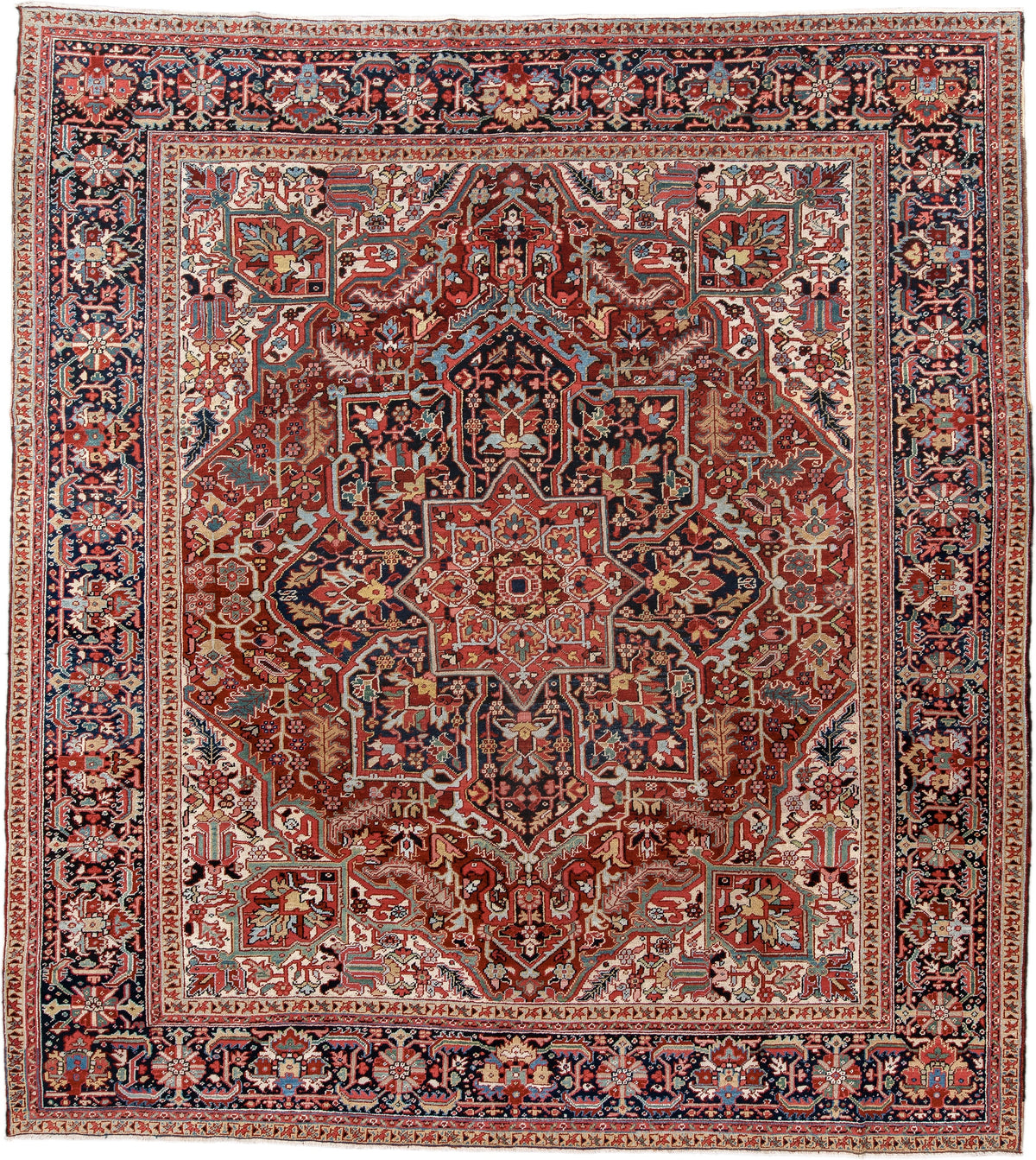
The city has traded in carpets for centuries. In the late nineteenth century its merchants, who had been shipping older rugs to Europe, set up their own workshops and wove in the sizes and colors that European and American buyers asked for. That export trade is why the type covers such a wide range of designs, and why so many Tabriz rugs come in the room sizes a Western house uses. The villages of the Heriz district, in the mountains just east of the city, wove many of the same medallion layouts in straight lines and sharp angles, so a rug from Heriz Rugs laid next to a Tabriz shows the difference between a village rug and a city rug at a glance.
How to recognize a Tabriz
Start at the edges. A Tabriz border is usually wide and built in layers, a main band of vines and palmettes (the fan-shaped flower that runs through Persian design) between narrow guard stripes, and the pattern meets itself neatly at every corner. Then look at the field, which most often takes one of two layouts. One is a single medallion at the center with matching quarter pieces in the four corners, like the ivory medallion on a soft taupe ground of this Vintage Tabriz Area Rug (9' x 12'). The other drops the center and runs flowers and vines evenly from border to border, like the ivory, taupe and pale blue field of this Antique Tabriz Area Rug (5' x 8').
The range goes well past those two. This Antique Tabriz Area Rug (8' x 12') fills a crimson field with flowering vines and small animals and frames it with panels of calligraphy. Other Tabriz rugs divide the field into square garden plots, each holding its own tree or flower, or set a vase of flowers inside an arched prayer niche, like this Antique Tabriz Area Rug (4' x 6').

Choosing a layout for the room
Layout is the most useful thing to choose by, because it decides which room the rug suits. A medallion gives a room a center, so it belongs where the middle of the floor stays open: a living room with the sofa and chairs gathered around it, or an entry hall. An all-over floral field suits a room where furniture covers most of the rug, under a dining table or a bed, because the pattern keeps showing between the furniture legs and nothing important disappears. Size is rarely the obstacle: more than half of the Tabriz rugs we have right now are large, from 6' x 9' to 10' x 14', and the standard 9' x 12' is the most common size of all.
 Medallion Tabriz Rugs
A center for a room, with the seating gathered around it.
Shop
Medallion Tabriz Rugs
A center for a room, with the seating gathered around it.
Shop
 Floral Tabriz Rugs
Pattern that keeps showing between the furniture legs.
Shop
Floral Tabriz Rugs
Pattern that keeps showing between the furniture legs.
Shop
 Large Tabriz Rugs
From 6' x 9' up, most often the standard 9' x 12'.
Shop
Large Tabriz Rugs
From 6' x 9' up, most often the standard 9' x 12'.
Shop
Antique or vintage
Tabriz weavers clipped the pile short so the fine pattern would stay sharp, and age decides how much of that pile is left. An antique Tabriz, meaning a rug eighty years and older, has usually worn down close to the knots, so it lies thin and flat and shows every line of the design right at the surface; it is at its best in a formal living room or a study that sees guests more than daily traffic. A vintage Tabriz keeps more pile standing, which makes it the softer choice underfoot and the sturdier one for a family room or a bedroom. About two thirds of the Tabriz rugs we have are antique.
 Antique Tabriz Rugs
Worn thin and flat, every line at the surface.
Shop
Antique Tabriz Rugs
Worn thin and flat, every line at the surface.
Shop
 Vintage Tabriz Rugs
More pile standing, softer underfoot.
Shop
Vintage Tabriz Rugs
More pile standing, softer underfoot.
Shop
Ivory, blue, or warm
Color is where Tabriz rugs differ most from one another. About half of what we have sits on an ivory or cream ground, the light, formal look for a dining room with dark wood furniture or a living room with pale walls. A smaller group carries a sky-blue or pale blue field, calm enough for a study or a bedroom. A warm group leans into crimson, rust and rose, the choice for a library or a north-facing living room that runs cool. Nearly all of them have softened with age, so even the reds read gentler than they would on a new rug.
 Ivory Tabriz Rugs
A light ground for dark wood and pale walls.
Shop
Ivory Tabriz Rugs
A light ground for dark wood and pale walls.
Shop
 Blue Tabriz Rugs
Sky-blue fields for a study or a bedroom.
Shop
Blue Tabriz Rugs
Sky-blue fields for a study or a bedroom.
Shop
 Warm Tabriz Rugs
Crimson, rust and rose for a room that runs cool.
Shop
Warm Tabriz Rugs
Crimson, rust and rose for a room that runs cool.
Shop
Placement follows the layout. Pull the front legs of the sofa and chairs onto a medallion rug and leave the medallion itself in open view; under a dining table, let the rug run at least two feet past the table on every side so the chairs stay on it when they slide out. Care is simple: vacuum without the beater bar, rotate the rug once a year so light and traffic wear it evenly, and send real spills to a professional cleaner.
If you are shopping the type rather than one particular rug, settle the size first and the layout second. This Antique Tabriz Area Rug (9' x 12'), a recent arrival, is the all-over version at full living room size in blue gray, ivory and taupe. For the largest rooms, this Antique Tabriz Area Rug (12' x 19') sets a small ivory medallion inside a navy and rust field of tiny repeating flowers. Every one is hand-knotted and one of a kind, the kind of rug a dining room or a formal living room is planned around.
One of a kind, photographed flat Every Tabriz in the shop, on one page Explore All Tabriz Rugs