
An oversized rug does one thing a merely large rug cannot: it puts every piece of furniture in a great room on the same surface. The seating, the walkway, and the dining end stop reading as three separate zones with bare floor between them, and the space finally reads as one. Past roughly twelve feet that is the entire job, and it is what the Oversize Rugs collection is built around.
Rugs this size were never mass produced. A loom wide enough for a fourteen foot carpet had to be built for the purpose, and the weaving ran for years. That is why the oversized end of the market is almost entirely antique and vintage, and why sizes past thirteen feet arrive in ones and twos rather than in stacks.
The rule for sizing a big room
Measure the seating area, not the room. Add eighteen to twenty four inches of bare floor on every side of it. That number is your rug size, rounded up to the nearest size that actually exists.
Two checks catch most mistakes. All four legs of every major piece, the sofa, the chairs, the console, should land on the rug; if the back legs hang off, the rug is too small. And the rug should stop a foot or more short of the walls on the narrow sides, so the floor still frames it.
Run that on a real room and the numbers climb fast. A 16 by 20 foot great room with a sofa and two chairs wants something close to 13 by 16. A combined living and dining space at 18 by 22 wants 14 by 16 or larger. A 9 by 12, which is where most people start, floats in the middle of either one and makes the room read smaller than it is.
The sizes that hold a whole layout
Three sizes do most of the work at this scale. 13 by 16 is the deepest of them and the place to start on an open plan floor, because it carries a seating group and its walkway together. 14 by 16 is where the rug sets the proportions of the room rather than sitting inside them, so the pattern matters more than it does at 9 by 12; weak drawing gets exposed across fourteen feet. 15 by 20 is the top of the range, woven for ballrooms and galleries, and it reaches the market a few pieces at a time.
 13' x 16' Rugs
The deepest of the three, and the one to start with.
Shop
13' x 16' Rugs
The deepest of the three, and the one to start with.
Shop
 14' x 16' Rugs
Sets the proportions of an open plan floor.
Shop
14' x 16' Rugs
Sets the proportions of an open plan floor.
Shop
 15' x 20' Rugs
Ballroom scale, and rare by nature.
Shop
15' x 20' Rugs
Ballroom scale, and rare by nature.
Shop
A long great room that runs well past sixteen feet is the case for 14' x 17' Rugs, which is thin by nature and worth checking alongside the size you came in for.
When twelve feet is not quite enough
Plenty of rooms sit just past the standard twelve foot sizes without needing a fourteen foot carpet: a near square great room, a large dining space where a long rug would leave two awkward strips of floor, a living room a couple of feet wider than the plan you measured for. 12 by 14 is the first real step up, 13 by 14 is the squarest of the group, and 13 by 15 is the forgiving middle when 13 by 16 runs long. If your room is closer to square still, 12' x 13' Rugs is worth a look.
 12' x 14' Rugs
The first real step up from a standard twelve foot plan.
Shop
12' x 14' Rugs
The first real step up from a standard twelve foot plan.
Shop
 13' x 14' Rugs
The squarest of the group, for a near square floor.
Shop
13' x 14' Rugs
The squarest of the group, for a near square floor.
Shop
 13' x 15' Rugs
The forgiving middle when 16 feet runs long.
Shop
13' x 15' Rugs
The forgiving middle when 16 feet runs long.
Shop
Which weaves come this big
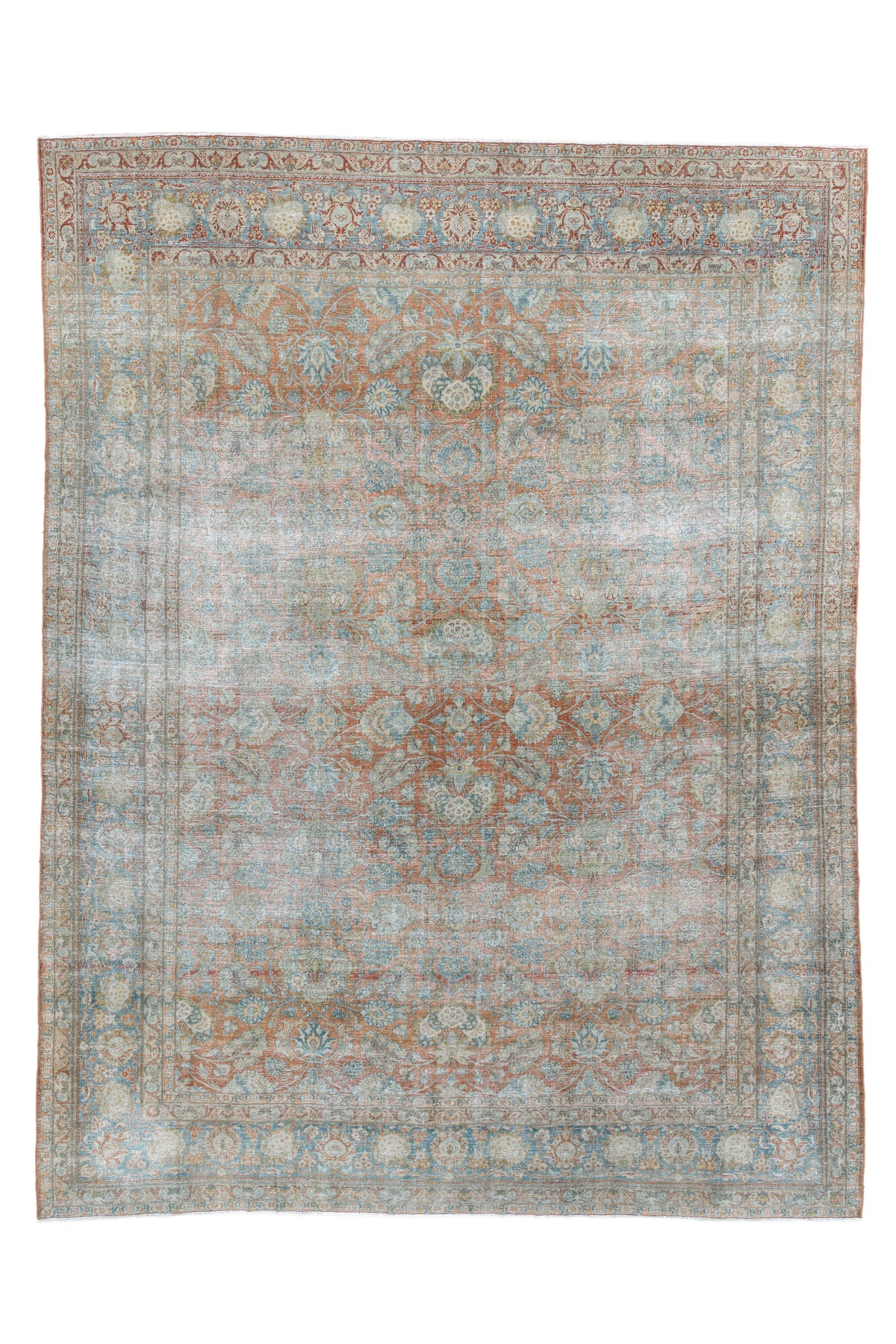
Turkish Oushaks carry the most pattern at this scale. Workshops in western Anatolia wove them in room sizes for large European and American houses, in soft terracotta, ivory, and sky blue palettes that hold up under the light an open plan gets. Start with Oversize Oushak Rugs if you want a design that fills the floor without weighing it down.

For weight and drawing, the Serapi and Heriz carpets of northwest Persia are the ones to know. The pattern is bold enough to read from across a wide room, which is exactly what a floor this size asks for. The Antique Serapi Area Rug (15' x 20') shows it plainly: terra cotta and indigo on ivory, hand knotted in wool more than eighty years ago, at a scale a great room can absorb rather than be overwhelmed by. Persian Sultanabad and Mahal carpets came out of the same export trade, with spacious repeating patterns that do not compete with a busy furniture plan, and Oversize Sultanabad Rugs gathers the ones we have at this size.
Turkish Tulu weaves cover the opposite instinct. Long soft pile, quiet color, almost no pattern at all. When a room already carries a lot of art and texture, a piece from Oversize Tulu Rugs gives it scale without adding another argument to the floor, and it is the largest group we carry above twelve feet.
Living with a rug this size
Buy the pad with the rug. A carpet this heavy will not shift much, but a good pad takes the load off the foundation and adds years to it. Rotate it once or twice a year so the traffic lane and the sunlit corner wear at the same rate.
Vacuum with the beater bar off, or on a bare floor setting, and go with the pile rather than against it. For anything spilled, blot rather than rub and get it to a professional rug cleaner; a piece at this scale is not a job for a home machine. Delivery is a two person task, and an oversized carpet should always travel rolled, never folded.
If you are working out which size your room actually needs, measure the seating area first and let the rule above round you up. The whole range sits on one page in Oversize Rugs, and at this end of the catalog it pays to see what exists before you settle on a number.
One of a kind, photographed flat Every oversize rug in the shop, on one page Explore All Oversize Rugs